


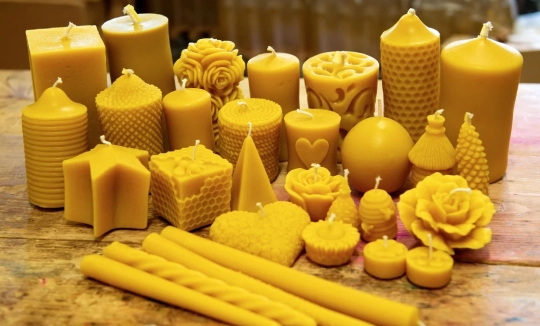
Beeswax possesses anti-inflammatory and antioxidant properties, which is why it is widely used in the production of ointments, plasters, and medicinal candles. For bees, producing wax is highly energy-consuming: to make just 1 kg of wax, they must consume about 4 kg of honey. Despite this, beeswax is a unique product that can retain its qualities for centuries. Laboratory research has confirmed that beeswax found in Egyptian pyramids has preserved all of its physical and chemical properties to this day. In ancient times, beeswax held great importance and was even used as a form of currency. While honey was referred to as “liquid gold,” beeswax was considered “gold bullion.” At first, people believed that bees collected wax from flowers in the same way they gathered pollen. In reality, wax is produced within the bees’ own bodies. Each bee can be compared to a small biochemical laboratory, capable of producing wax, honey, propolis, royal jelly, and venom. The wax comb is vital for the survival of a bee colony: without it, the queen cannot lay eggs, and the colony cannot reproduce. Within the comb, nectar is transformed into honey, and pollen becomes bee bread. Beehive combs can be likened to multi-story apartment buildings. Over the course of a season, a bee colony constructs a “skyscraper” large enough to house around 30,000 bees.Throughout evolution, bees have undergone little natural selection, which indicates their high level of perfection. The wax comb has played a crucial role in this perfection.For storing bee products, the wax comb is the ideal container. Despite the high humidity inside the hive, the antibacterial properties of beeswax ensure that honey does not ferment before ripening, and pollen does not become moldy. Thanks to these qualities, beeswax is the most reliable natural packaging for preserving the beneficial properties of all bee products.