


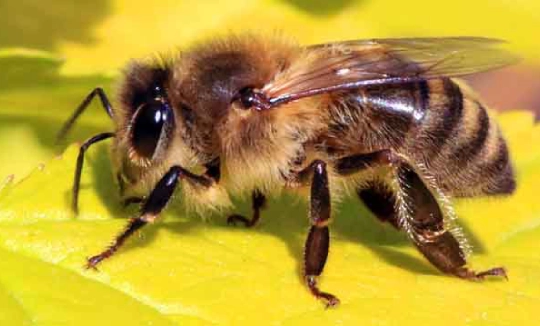
The Caucasian grey bee is distinguished by several unique traits: a long proboscis, moderate swarming tendency, high resistance to low temperatures, and remarkable gentleness. The world first learned about its uniqueness in 1961 at the International Horticultural Exhibition in Erfurt, Germany. Two bee colonies brought from the Chkhorotsku breeding farm collected 97.3 kg of honey and were awarded the gold medal. The Georgian bee went on to win two more gold medals, in 1965 and again in August 1971, gaining worldwide recognition. Thanks to its long proboscis, the Georgian bee can more easily extract nectar from flowers. This adaptation not only allows it to gather larger amounts of honey but also makes it an efficient pollinator of a wide variety of plants. It was precisely this feature—the length of its proboscis—that proved decisive in 1961, earning the Georgian bee its first international gold medal. The Greek mathematician Pythagoras, who lived to the age of 90, claimed that the secret of his long and, most importantly, productive life was his daily consumption of honey. Honey is indeed a remarkable product—a priceless gift of nature and a true treasury of beneficial substances. It is rich in amino acids, enzymes, vitamins, minerals, carbohydrates, essential oils, and lipids. Since ancient times, people have regarded it as an elixir of health. Did you know that in order to produce just 1 kilogram of honey, bees must leave the hive about 4,500 times and visit between 6 to 10 million flowers for nectar? A strong bee colony can collect 5–10 kg of honey (10–20 kg of nectar) in a single day. Over the course of its entire life, a single bee consumes on average only about 1/12 of a liter of honey, which is roughly 400 grams.